

Freesia is new to our fall bulb line up, and we have some really beautiful varieties in our collection. Our 2026 fall-winter listing includes 9 different varieties, mostly double-flowering. Here is a helpful guide for growers who are getting started with freesia.
Planting Freesia Corms
Starting with quality planting material is one of the most important steps in producing beautiful freesia stems. Freesia are grown from corms, which store the energy needed for initial root and shoot development. Larger, healthy corms generally produce better flowering results, so start with good-quality material from a reputable supplier. You’ll find our freesia listed in the “Fall Misc. Bulbs” web catalogue when you log in to your wholesale account.
Preparing Corms for Planting
For the commercial production method recommended for our freesia series, dip corms in water and a light fungicide solution for 15–20 minutes before planting. Plant within a few hours of dipping.
You can use RootShield WP as a dry dust coating on the corms right before planting, or mix it into a liquid dip slurry.
Always use a fungicide registered for the intended crop and application, following its label directions. This treatment should not be considered a substitute for clean growing media, good drainage, and proper sanitation.
Pre-treating the corms with a fungicide can help prevent fusarium rot. The process is similiar to pre-treating lisianthus plugs.
Planting Depth and Spacing
Plant corms approximately 2 inches below the soil surface, with the growing point facing upward.
Freesia corms are densely planted with just 1-1.5 inches between plants. If you are planting in pots, you can plat 3 corms per quart pot or 5 per gallon pot.
Growing Media
Freesia likes growing media that holds moisture well. This is particularly important during flowering, when plants are sensitive to drying out.
However, moisture retention should never come at the expense of drainage.
For containers, choose a quality growing medium that retains water while allowing excess moisture to drain freely. A professional potting mix with good structure is a great starting point.
For in-ground production, choose loose, fertile soil with good drainage. Incorporating finished compost can improve soil structure and moisture retention. If your farm has heavy clay soil, consider raised beds or containers instead.
Avoid letting plants sit in saturated growing media, as excessive moisture can encourage corm and root rot.
Temperature and Light
Freesia is a cool-weather crop, and temperature management is one of the biggest factors influencing successful production.
The ideal temperature range is:
Night temperatures: 40–55°F
Day temperatures: 50–70°F
Cooler temperatures encourage flower initiation and help maintain compact plant growth.
For growers in southern states, freesia can often be grown directly outdoors during the cooler growing season.
For northern growers, including those in the Northeast, a cool greenhouse or protected structure is generally a better option. Protect plants from frost and avoid allowing greenhouse temperatures to climb excessively.
Light is equally important.
Freesia requires high light levels, ideally around 4,000–6,000 foot-candles. Adequate light helps keep plants compact and encourages stronger growth. If you are not familiar with a light meter or foot candle measurements, this post and video demonstration from Little Farmhouse Flowers is helpful.
In northern states, winter light levels can be challenging. For outdoor growing/greenhouse growing without supplemental light, we recommend waiting until at least early January to plant when natural light levels are more favorable.
If you have supplemental lighting, you will have more flexibility with your planting schedule.
A combination of high light and cool temperatures is particularly important for producing sturdy, marketable stems.
Container Production
Growing freesia in containers is a good option for farms with limited greenhouse space, growers who want to trial multiple varieties in a small space, or anyone who needs flexibility in managing temperature and light.
Containers can be grown in:
Cool greenhouses.
High tunnels.
Unheated hoop houses during suitable weather.
Protected outdoor growing areas.
Indoor growing spaces with sufficient light and temperature control.
One of the biggest benefits of container production is the ability to move plants as conditions change.
Use quart or gallon pots, following the recommended planting densities of 3 corms per quart or 5 corms per gallon.
Water immediately after planting. After this initial watering, allow pots to remain relatively dry until shoots begin to emerge.
Once sprouts have developed, maintain consistent moisture. Do not allow pots to dry out, especially during flowering.
For commercial container production, aim for an electrical conductivity (EC) of approximately 0.9 and a pH around 6.8. Monitor your growing medium and irrigation water to maintain appropriate levels.
In-Ground Production
For farms with available growing space, in-ground production can be an economical way to grow larger quantities of freesia.
Prepare beds with loose, fertile, well-draining soil. Raised beds are especially helpful in regions with heavy rainfall or poorly draining native soils.
Choose a location with high light exposure and protection from strong winds. Freesia need a sunny location.
Install drip irrigation where possible, as this helps maintain consistent soil moisture without unnecessarily wetting foliage.
Because freesia stems can become top-heavy, we strongly recommend installing horizontal support netting early in the growing process. This helps keep stems straight and makes harvesting easier.
In-ground production is particularly appealing for growers in milder climates who can take advantage of naturally cool outdoor growing conditions.
For northern growers, protected beds in a cool greenhouse or high tunnel can be a good alternative to containers, provided temperatures and light levels are suitable.
Watering and Feeding
Freesia has a fairly specific watering preference, particularly during its early development.
Immediately after planting: Water pots thoroughly to settle the growing medium around the corms.
Before sprouting: Do not continue watering regularly. Allow the corms to begin developing shoots before resuming irrigation.
After sprouting: Keep the growing medium consistently moist.
During flowering: Be especially careful not to let plants dry out. Moisture stress during flowering can contribute to crooked stems and poor flower quality.
For fertilization, monitor EC and pH, with approximate targets of 0.9 EC and 6.8 pH for the recommended container production system.
Use clean irrigation water. Freesia is particularly sensitive to fluoride, which can cause yellowing and browning along leaf margins. If you use city/town water for your farm, it may have fluoride.
Avoid superphosphate fertilizers (mineral fertilizers made from acid-treated insoluble phosphate rock) and check your water source for fluoride before beginning production.
How Long Does Freesia Take to Flower?
Approximate crop times from planting to flowering are: 10-14 weeks. This is a general production estimates. Actual timing depends on planting date, light levels, temperature, and growing conditions.
Keep records of your planting dates and first harvests so you can fine-tune your production calendar each season.
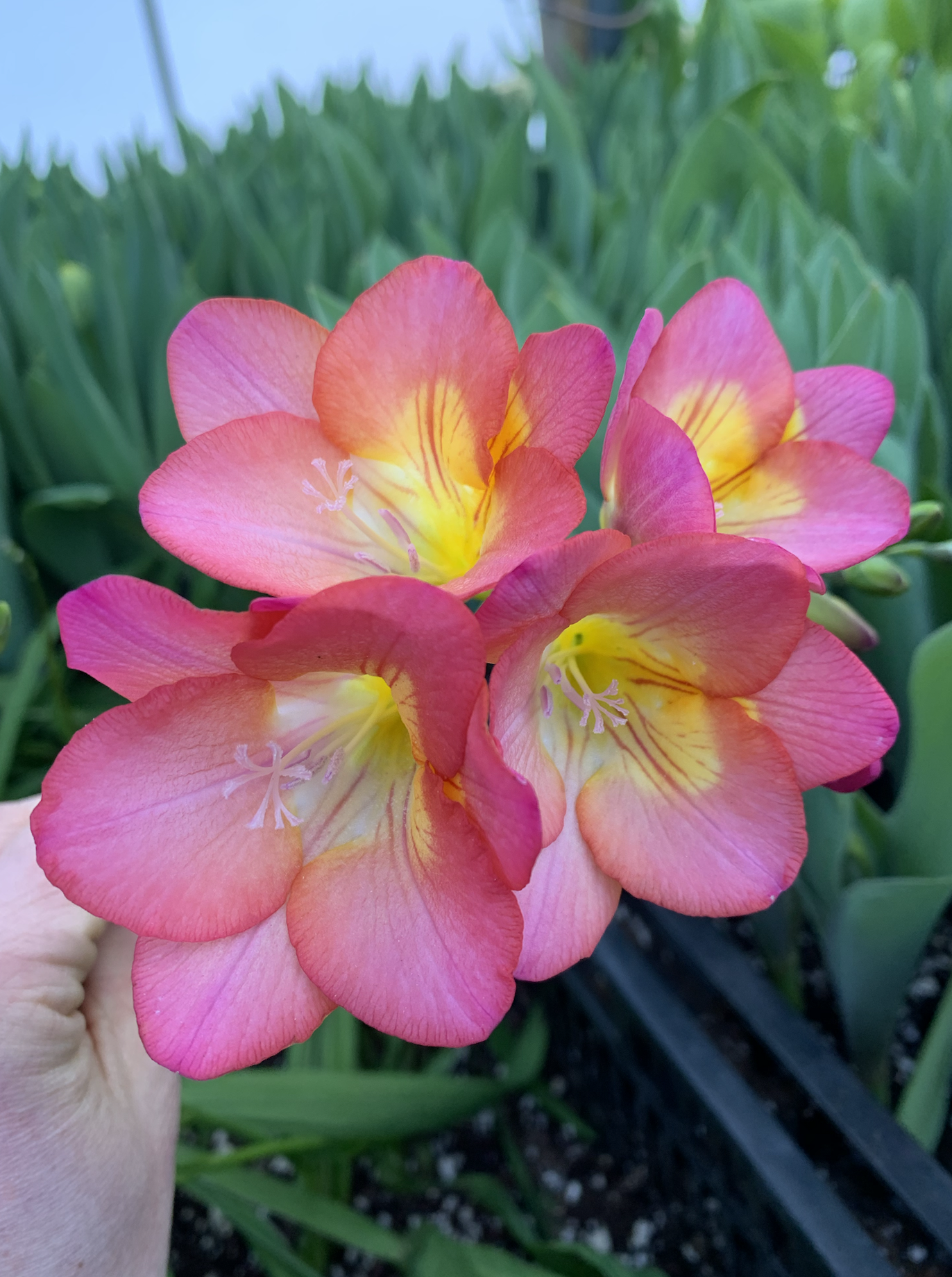
Flowering and Harvesting Freesia
Freesia needs cool nights to flower successfully. As plants begin developing flower spikes, pay particular attention to nighttime temperatures and consistent moisture.
The goal is to produce strong, straight stems with well-developed flower spikes and plenty of buds.
For cut-flower production, harvest when the first flower is showing color and beginning to open, with additional buds showing color behind it.
If growing freesia in pots for sale as flowering plants, display plants for sale when the first flower is showing color.
For cut stems:
Harvest during the coolest part of the day.
Use clean, sharp shears.
Place stems immediately into clean water.
Remove foliage that would sit below the waterline.
Move stems into a cool postharvest area as quickly as possible.
Freesia is sensitive to ethylene, which can cause developing buds to fail to open. Keep harvested stems away from ripening fruit and aging flowers.
Commercial growers should pay particular attention to postharvest temperature and handling. Mississippi State University Extension recommends harvesting when the first floret is plump and beginning to open, with at least two additional buds showing good color.
Common Freesia Problems
Even with good growing conditions, freesia can occasionally develop problems. Understanding the underlying causes can help you correct issues before they affect your harvest.
Problem: Plants do not flower
Likely cause: Soil temperature above 60°F (Review temperatures during flower initiation.)
Problem: Yellowing along leaf edges, progressing inward
Likely cause: Fluoride exposure. (Check irrigation water and growing media.)
Problem: Crooked flower stems
Likely cause: Humidity fluctuations or drying during flowering. (Maintain consistent moisture and environmental conditions.)
Problem: Stretched plants
Likely cause: Insufficient light or excessive heat. (Improve light and lower temperatures where possible.)
Problem: Poor flower development
Likely cause: Temperature stress. (Monitor day and night temperatures.)
Insects and Diseases
The most common pests and diseases to watch for include:
Thrips.
Green aphids.
Botrytis (gray mold).
Regular scouting is important, especially in greenhouses and high tunnels where pests can multiply quickly.
Maintain good airflow, avoid excessive humidity, remove diseased plant material, and keep production areas clean.
Can You Save Freesia Corms?
Yes! Freesia corms can be lifted, stored, and replanted, although getting reliable repeat flowering requires more specific treatment than many other bulbs.
After flowering, allow the foliage to continue growing until it yellows and dies back naturally. This allows the plant to replenish its underground storage structures.
Once the foliage has dried:
Lift corms carefully.
Remove excess soil.
Allow them to dry in a well-ventilated location.
Separate healthy new corms and cormlets.
Discard damaged or diseased material.
Dutch commercial growers use carefully controlled warm storage treatments to prepare corms for another production cycle. Penning Freesia recommends storing lifted corms at approximately 82–86°F for at least three months before replanting, with additional attention to the correct rooting and preparation stages.
This is one reason many flower farmers choose to treat freesia as an annual crop and purchase fresh, professionally prepared corms each season.
If you want to experiment with saving your own, start with a small batch and keep detailed records.
Happy growing!
We're excited to help growers explore the possibilities of specialty bulbs and corms. We’ve enjoyed growing it on our own trial farm in USDA zone 5. They bloom with natural light in a greenhouse in early March on our farm. We can achieve earlier flowers in the basement grow room.
Freesia has one of the most lovely flower scents. The blooms are long lasting and hold up well without water in bouquets, corsages, and boutonnieres. We hope this guide gives you the confidence to give freesia a try!