

Calla Cultivation
There are a number of factors that can impact the quality of cut flower calla stems.
Professional calla lily growers use a combination of variety choice, environmental control, and cultural practices to consistently produce very long, straight stems for the cut-flower market. Here are the key methods used in commercial production.
These techniques can be applied to calla rhizomes planted in the ground OR in containers, such as bulb crates or individual pots.
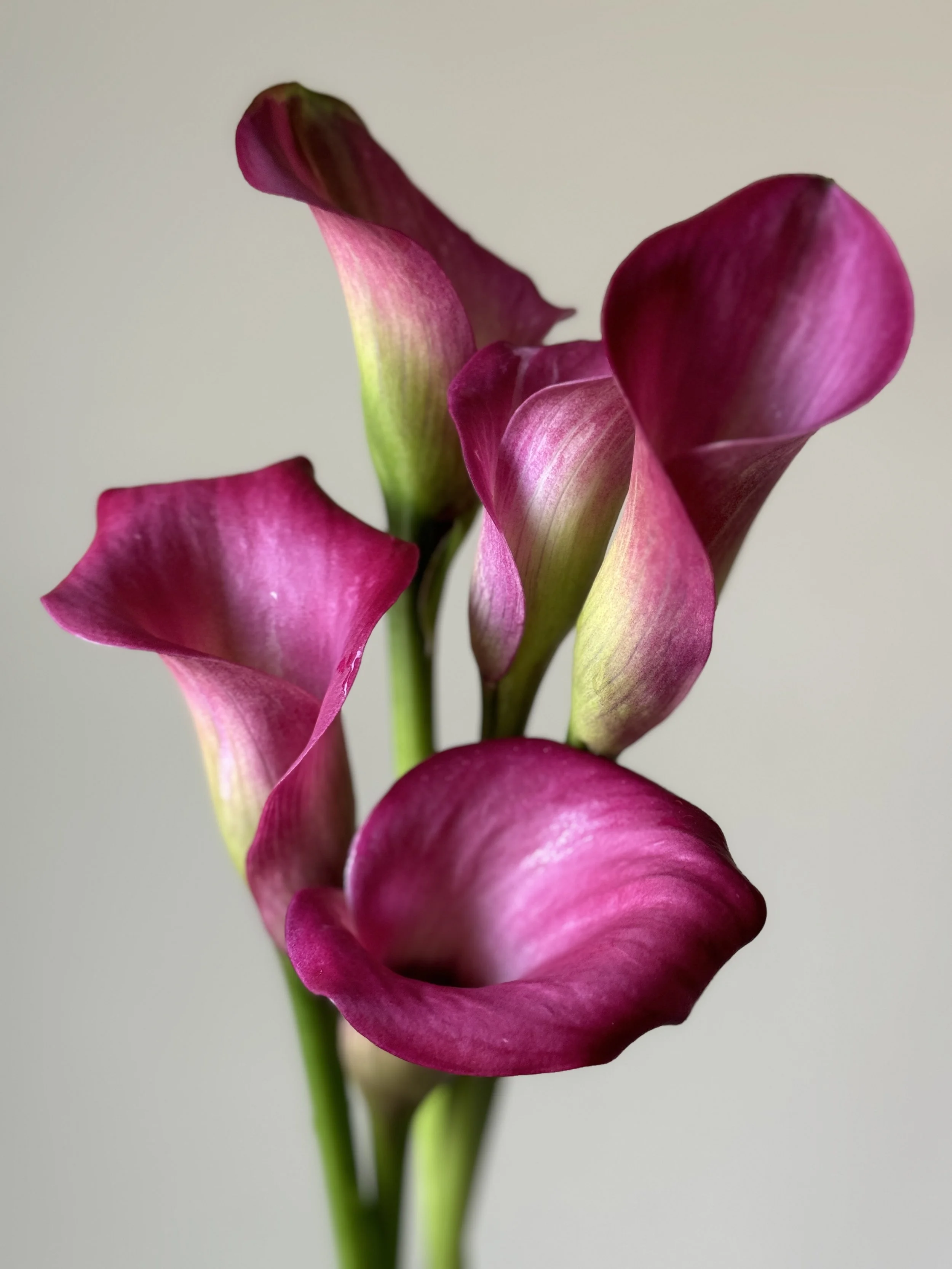
1. Choose naturally long-stem cultivars and large rhizome size.
Some calla varieties are genetically predisposed to produce longer stems. Professional growers typically use cultivars that can reach 50–90 cm stems under optimal conditions. Rhizomes for cut flower growing should be size 14/16 or larger. The larger the rhizome, the more (and larger) flowers it will produce. We offer size 14/16, 16/18, and even some premium - size 18/20 calla rhizomes. We select calla varieties that are suited for cut flower work and whose flowers are offered in the international cut flower marketplaces. Our calla rhizomes are imported directly from our partners in The Netherlands.
2. Dense planting for natural stretching
Commercial growers intentionally plant callas much more densely than hobby growers:
Usually 40–60 rhizomes per square meter, depending on the cultivar.
The crowding encourages vertical stem elongation as plants compete for light.
This is one of the biggest industry secrets—dense spacing produces longer stems.
3. Warm soil + controlled temperatures
Temperature has a direct effect on stem length and quality.
Optimum temperatures:
Day: 18–24 °C (65–75 °F)
Night: 12–15 °C (54–59 °F)
Warm soil at planting (16–18 °C / 60–65 °F) speeds sprouting and promotes vigorous elongation.
Too cold = short, weak stems
Too hot = short, rushed flowering
4. Light manipulation
Callas produce longer stems when light is:
Bright but diffused (80–90% full sun equivalent)
Evenly distributed to prevent wobbling or bending
Professional greenhouses use:
Shade cloth (20–40%) in hot climates
Supplemental lighting in winter to keep day length around 12–14 hours
Low light → stretching (but weak stems)
Correct light → long + strong stems
5. Adequate but not excessive nitrogen
Fertilizer strategy is crucial:
General commercial formula:
Start: higher N (e.g., 15-5-20) for canopy growth
After shoots form: reduce nitrogen and increase potassium (e.g., 12-8-30)
Too much N → floppy stems
Balanced K → strong long stems
Growers typically fertigate weekly with EC 1.2–1.5.
6. Consistent moisture
Callas need:
Constantly moist but not waterlogged soil
20–25% volumetric water content (for pot culture)
Good drainage to prevent rhizome rot
Moisture stress at any point → flowers emerge shorter.
Commercial growers often use:
Drip irrigation with tensiometers or moisture sensors
Coir-based substrates to maintain uniform moisture
7. Deep planting
Rhizomes are often planted 7–10 cm (3–4 inches) deep.
Deeper planting encourages:
Longer, sturdier stems
Better hydration from the substrate
Some growers mound the soil slightly for additional stem support.
8. Harvest timing
Professional growers harvest:
When the spathe has just opened (still firm)
Cutting deep into the plant at the base of the stem
This deep cut stimulates replacement stems that are longer.
If harvested too high → subsequent stems get shorter.
9. Temperature & humidity during pre-harvest and postharvest
To keep stems long and straight:
Maintain 60–80% humidity to prevent stress
Avoid heat or drought in the 10–14 days before cutting
Immediately hydrate stems in cold clean water after harvest
Store at 4–5 °C (39–41 °F) if needed
Summary of the most impactful techniques:
If you want to replicate professional long-stem production, prioritize:
Choose long-stem cultivars
Plant densely
Control temperature
Use bright but diffused light
Fertilize for strong stems (high K, moderate N)
These 5 factors alone account for most differences between hobby and commercial calla stem lengths. To view our cut flower calla rhizome availability, please see our “Spring Bulb” catalogue. Calla rhizomes ship in the spring, but may be pre-ordered (reserved) as early as the summer the previous year.